
Sources for Lake Elsinore Previous Residents
A house history needs more than a deed. The Recorder can show transfers and liens, but a deed party is not automatically an occupant. Haines reverse directories can provide dated address listings. Federal census schedules show households every ten years. Permits can place project participants at an address. Newspapers, death records, and probate can explain when a household changed. Each source answers a different part of the previous residents question.
The table separates those source roles and their real local coverage. The dates are documented research stops, not a promise that every year or every street survives. Earlier land records can cross predecessor-county lines because Riverside County was created in 1893.
| Source | Years it covers | Where held | What it shows |
|---|---|---|---|
| Recorder online index | Jan. 1, 1974-present | Riverside ACR self-service | Party-indexed deeds, liens, dates, numbers, types |
| Earlier deed and index books | 1893-1973; predecessor groups may reach earlier | Recorder office, books, microfilm, archives | Grantor, grantee, legal description, book-page references |
| Haines reverse directories | 1971, 1986, 1991, 1996, 2001, 2006-07 | Documented ERIS/source libraries | Address to listed occupant or business |
| Federal census | Through 1950 public | NARA, FamilySearch, library databases | Household, age, relationship, birthplace, occupation |
| Sanborn map | August 1892, two sheets | Library of Congress | Building footprint, use, materials, street label |
| Newspaper, probate, and death evidence | Publication or event dependent | CDNC, libraries, Superior Court, vital custodians | Life event, heir, death, and address narrative |
Use the source that fits the question, then cross-check before calling a person a past resident.
Start with Current Lake Elsinore Records
Begin a previous residents search with the present street address in the Riverside County Assessor property search. Save the APN, situs address, legal-description or map reference, tract, lot, block, and any transfer clue shown through an authorized channel. The web search accepts address, APN, and PIN. It does not promise an online owner-name display, so use the Assessor's public-service office route when the name is needed.
An APN is a better starting key than a surname. It survives ordinary postal formatting changes and links the Assessor, GIS, recorded maps, deeds, and permits. Keep the owner mailing address separate from the situs. The mailing address may belong to a different place, a trust, or a service contact. Neither a mailing line nor a homeowner exemption proves who lived in the building.
- APN
- The county parcel identifier that connects assessment, GIS, tax, and deed research.
- Legal description
- The tract, lot, block, map, or metes-and-bounds description that identifies land in a recorded instrument.
- Chain of title
- The sequence of recorded transfers and interests tied to the same parcel.
- Occupant
- A person listed at an address in a dated source, which is not the same as owner.
That stable-key method keeps previous residents connected to the right property even when the street label changes.
Note: The APN carries the house history across changing street labels, but it does not turn an owner into an occupant.
Walk the Lake Elsinore Deed Record Chain
Once the current owner is obtained through the proper Assessor channel, search the Riverside Recorder index for that person as grantee near the acquisition date. Inventory the grantee, grantor, recording date, document number, deed type, and legal description. Treat the earlier deed's grantor as the next name to search as grantee. Repeat the role reversal for each prior transfer.
- Match the current parcel address to APN, legal description, tract, lot, or block.
- Search the likely grantee in LAST FIRST MI format, then test initials, spouses, trusts, and spelling variants.
- Save the recording number, date, document type, grantor, grantee, and legal description before ordering a copy.
- Use the prior grantor as the next grantee and compare the legal description again.
- When the online chain reaches 1974, switch to recorder books, index volumes, microfilm, public terminals, or staff requests.
The web index begins January 1, 1974. Copies are available online, in person, or by mail, with regular and certified options. A reconveyance or deed of trust is not automatically a sale, so document type matters.
The Riverside Recorder name search is the party-index route for the modern part of the chain.
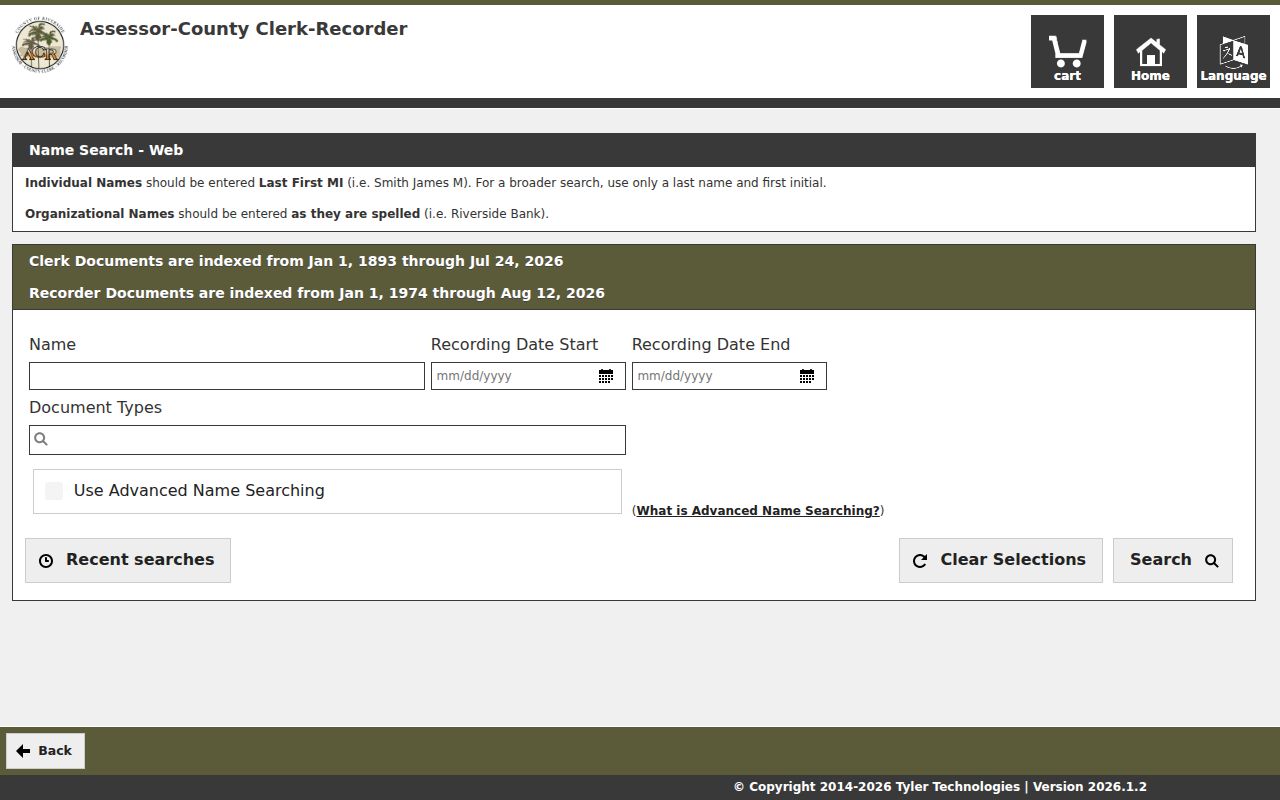
The search screen illustrates why a previous residents trail must retain party roles instead of treating every indexed name as a resident.
Lake Elsinore Records before 1974
Older Lake Elsinore property work moves offline. Riverside County's Clerk-document index reaches January 1, 1893, but Clerk coverage is not a substitute for earlier Recorder deed books. Use the Recorder's grantor and grantee index books, deed books, microfilm, public terminals, and staff-assisted retrieval. For an instrument already identified by number or book-page, request that exact item rather than asking staff to perform open-ended genealogy.
Pre-1893 research needs a jurisdiction check. Riverside County was created from parts of San Bernardino and San Diego counties in 1893. An 1880s Elsinore title can therefore point into a predecessor-county record group. Follow the prior deed reference and consult the appropriate catalog instead of forcing the current Riverside label onto an older instrument.
The Riverside Recorder book and page search provides a distinct reference path when a document placement key is known.
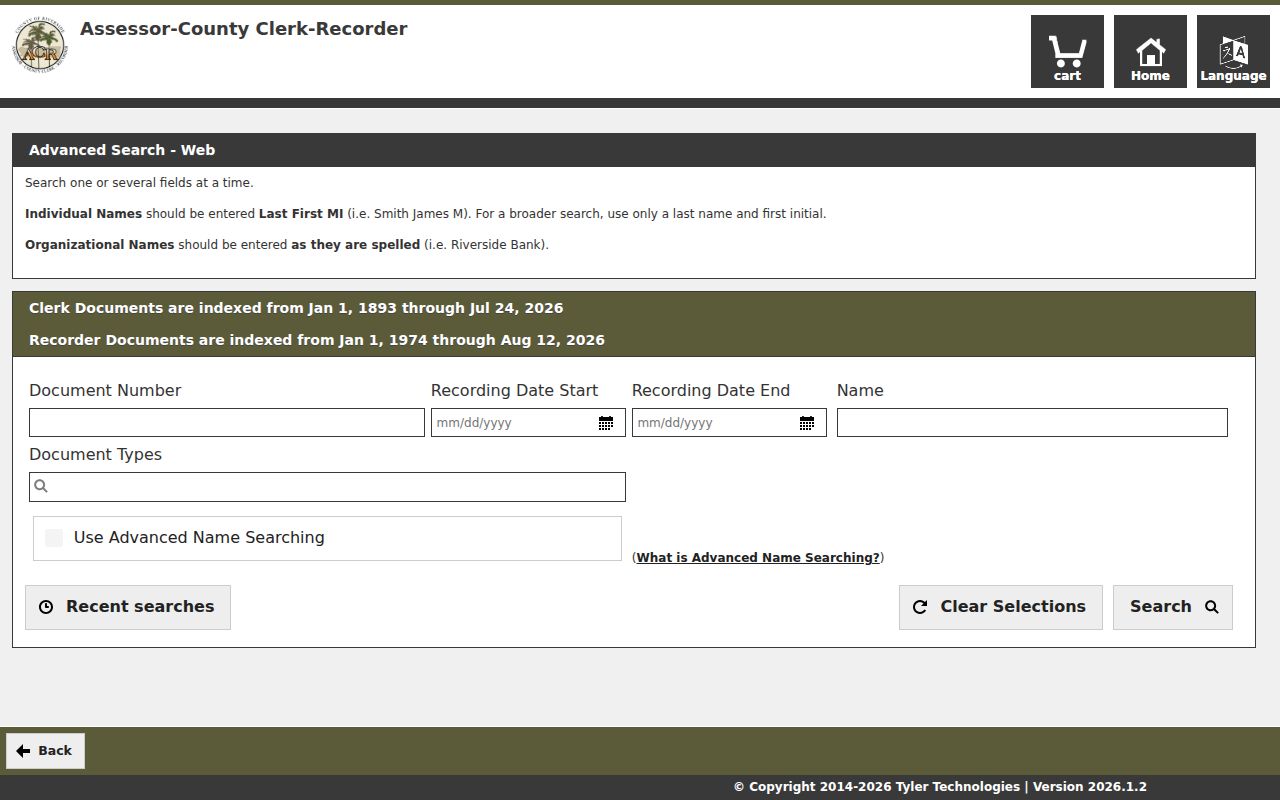
Preserving a book-page or document reference makes an older request precise and helps staff retrieve the right land record.
Note: The 1974 web boundary is an access cutoff, not the beginning of Riverside County's recorded land history.
Use Lake Elsinore Directories for Past Occupants
Deeds show ownership changes. Reverse or criss-cross directories can show who a publisher listed at an address between those changes. The documented Haines years are 1971, 1986, 1991, 1996, 2001, and 2006-07. Digital business directories are documented for 2012 and 2018. Sherman Library and Gardens reviewed business, city, cross-reference, and telephone directories from 1985 through 2010 at approximate five-year intervals.
These editions are snapshots. They can omit outlying streets, new subdivisions, apartments, or unlisted households. A “not listed” result is not proof that the building was empty. A nearby address can sometimes be reported when the exact one is absent, so preserve the report's wording. The edition, source, street number, name, and result status belong in one note.
The full collection history and entry-reading method appear in the Lake Elsinore city directory collections record. The previous residents angle uses those collections only as dated evidence for one address.
Pair Lake Elsinore Past Residents with Census
Federal census schedules provide household snapshots that can fill the spaces between directory editions. Public schedules currently run through 1950 under the 72-year rule. A census may show names, relationships, ages, birthplaces, occupation, and residence at enumeration. It does not prove a deed transfer or a present address. The 1890 schedules were largely destroyed, so local directories, deeds, assessment rolls, newspapers, and church or cemetery records are needed for the missing period.
Pair the closest census year with the nearest reverse-directory edition. Compare the street guide, enumeration district, household relationships, age ranges, and names. If the name moves, test a deed, obituary, probate filing, or newspaper notice. If the directory disappears, record the gap and look for a different repository or place-name heading.
The National Archives 1950 Census guide is the official access and release reference.
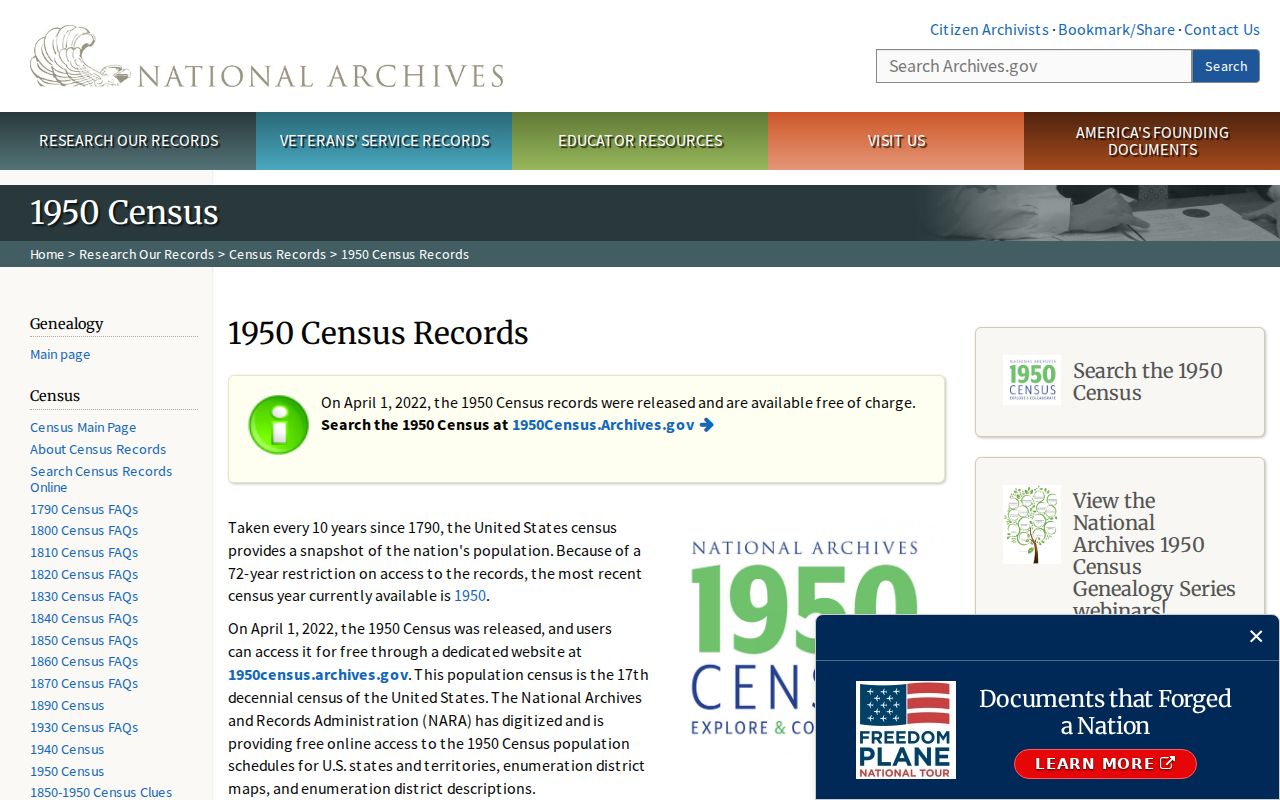
The census image belongs in a household timeline, not a claim that one schedule replaces all other evidence.
Note: Census and directory dates complement one another, but neither source replaces a deed or proves present occupancy.
Read 1892 Lake Elsinore Sanborn Map Records
The August 1892 Elsinore Sanborn set has two sheets. Its value is physical context: building footprint, materials, use, and historic street label. When a previous residents search reaches a street number that no longer matches, the map can show whether a structure or road label existed in that era.
Sanborn maps do not name occupants. Pair them with a directory, assessment book, deed, newspaper, census, or probate record. Compare the map's old street label with the legal description and recorded map. The town was indexed as Elsinore, so retain that name when searching the catalog.
The Library of Congress map item is a practical browse point when an address index stops, but it should remain a building-context source.
Date Work with Lake Elsinore Permit Records
City permit files can add a work date and project role to a house history. The building-permit application asks for project address, applicant, owner, contractor, architect, permit type, square footage, valuation, project description, trade quantities, date, and electronic signature. The Citizen Self Service portal supports submissions, status, uploads, payment, and plan collaboration. Public historical-search coverage is not published.
Request an existing file by street address, APN, permit or project number, work type, and date range. Ask for the application, issuance or final date, scope, contractor, inspection or final record, and any released project history. Do not assume that every field is public. Personal contact details, complaint material, or protected information may be withheld.
The Lake Elsinore permit portal is the submission and status route; the City public-records request portal is the fallback for existing records not exposed there.
Close the Lake Elsinore Probate Trail
Probate can explain the end of an ownership or household trail. A public case may identify a decedent, petitioner, personal representative, heir, or interested person. Pair the case with a post-death deed, trustee's deed, affidavit, death record, and newspaper obituary. Each source should retain its own date and role.
Riverside Superior Court's probate access begins with the case index and case number. Public filings can contain address and relationship facts, but confidential documents remain closed. A death certificate or obituary can point to the file without proving every relationship. Use the court's certified-copy and clerk procedures when a legal record is required.
An obituary is a useful bridge to family names and former towns. Search the California Digital Newspaper Collection, Riverside County Library resources, and local-history repositories, then verify the event with the vital-record custodian or court file.
Note: Probate and obituary clues become stronger when the APN, event date, and court or vital-record source agree.
Past Households Need a Lawful Record Trail
A house history can be documented for family history, a house story, heir research, or a property record question. It should not be reconstructed from a single uncertain name. Keep a dated timeline that distinguishes owner, listed occupant, household member, applicant, and person named in an event. A missing directory entry, protected address, or sealed file is part of the evidence boundary.
Lawful personal use. Lake Elsinore previous residents records are for personal research, genealogy, property history, and family reconnection. Do not use an address or name to stalk, harass, intimidate, threaten, or harm anyone.
For current parcels and every property along a named road, use the Lake Elsinore by-street address chain. For the directory collections and their documented years, use the Lake Elsinore city directories record. Each page owns a different part of the trail.
Note: A defensible house history records gaps openly instead of filling missing years with a likely-sounding name.